Duck Brand Foam Pipe Covers Review: Insulate Homestead Pipes Before They Freeze
This page reviews Duck Brand Foam Pipe Covers, an easy way to insulate indoor pipes to prevent freezing and reduce condensation. It explains how to use the foam covers, including measuring and installing them on your pipes. Suitable for DIY projects, it's a cost-effective solution for keeping your pipes protected during extreme weather.
As an Amazon Associate I earn from qualifying purchases.
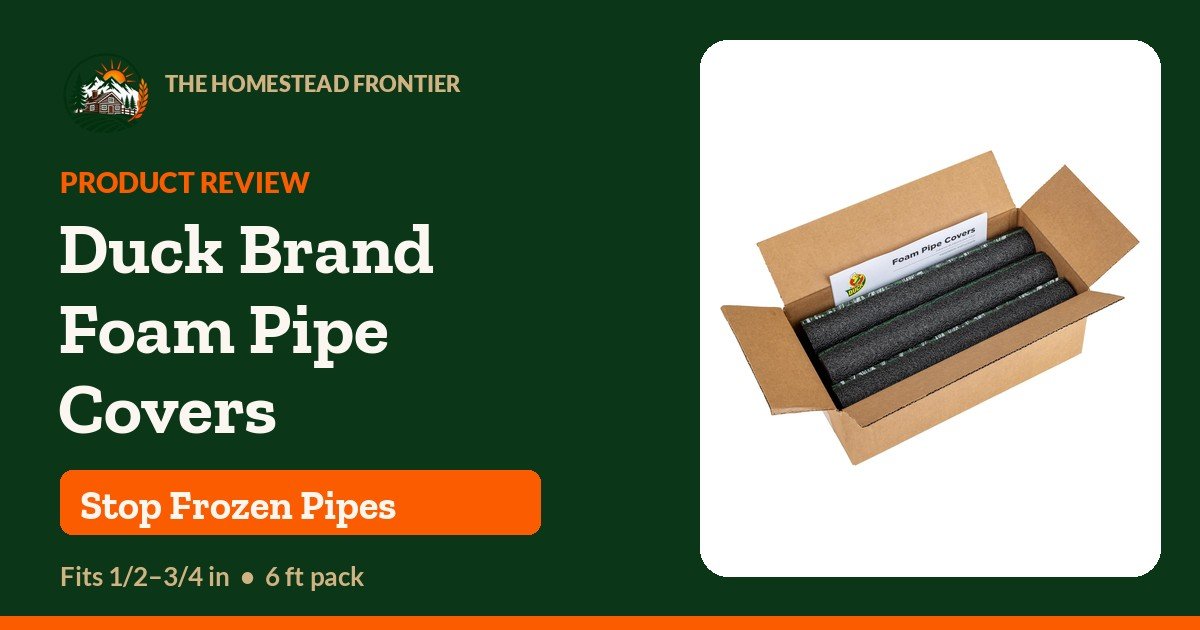
Exposed supply lines in a crawl space, basement, or pump house are the ones that freeze first. Duck Brand Foam Pipe Covers (model 288235) are a cheap, no-power fix: pre-slit foam sticks with a self-sealing adhesive edge that wrap around hot and cold water pipes. This pack gives you six 1-foot sticks—6 feet of coverage—sized for 1/2 to 3/4 inch pipes. Check your pipe size before ordering.
What It Is
These are black foam pipe insulation tubes made by Duck Brand (Shurtape Technologies). Each stick is 12 inches long. You get six per pack, for 6 feet of coverage. They’re pre-slit so they open easily and go on curved runs, and the edge has a self-sealing adhesive so you don’t need a separate roll of tape for every joint.
They’re meant for indoor water, air-conditioning, and HVAC pipes. The foam helps slow winter freezing and cuts summer “sweating” (condensation) that drips onto floors, feed, or stored goods. They’re rated safe up to 212°F and carry an R-value of 3.6.
Key Features
- Insulates hot and cold water pipes on indoor runs
- Pre-slit foam tubes that open easily and fit around curves
- Self-sealing adhesive edge for a quick close without leftover residue (renter-friendly)
- Helps prevent winter freezing and summer sweating on water, AC, and HVAC pipes
- R-value 3.6; safe for temperatures up to 212°F
- Fits 1/2″ to 3/4″ pipes — measure before you buy
- 6 sticks × 1 ft = 6 ft total; cut to length with scissors or a utility knife
How to Install
No special tools beyond scissors or a utility knife:
- Measure and cut. Cut each stick to the length you need. Leave a little extra to butt joints tight.
- Open the slit. Spread the pre-slit foam and wrap it around the pipe, including gentle bends.
- Peel and seal. Peel the adhesive strip and press the edges together for a closed seam.
- Finish joints. At elbows, tees, and valves, miter-cut the foam and tape the joints so you don’t leave gaps.
The short 1-foot sticks are handy in tight spaces between joists and fittings, with less waste on short runs than long tubes.
Things to Know
- Check your pipe size. These fit 1/2″ to 3/4″ pipe. Nominal size is not the same as outside diameter. Some 3/4″ steel or galvanized pipe is about 1.05″ OD and may be too big; 1″ lines need Duck’s 1-inch size. Measure the OD (or wrap a string around the pipe) before you order.
- Only 6 ft per pack. Measure your total run. Longer jobs are often cheaper with Duck’s 3-ft sticks / 12-ft packs.
- Rated to 212°F max. Keep it away from stove pipes, flues, and boiler or steam lines.
- It insulates; it does not heat. Foam slows freezing but won’t save a pipe in a long hard freeze or a drafty unheated space. Pair it with heat cable where needed, and follow the heat-tape maker’s instructions about covering it.
- Indoor use. The listing is for indoor pipes. Outdoor or sun-exposed foam usually needs a UV-resistant wrap or tape over it.
Who It’s For
This pack is for homesteaders and DIY owners with short exposed runs: crawl spaces, basements, well or pump houses, milk rooms, mudrooms, and unheated utility rooms. It’s also useful on hot-water lines off the water heater to cut heat loss, and on cold or AC lines that sweat in humid summers.
If you want a first, cheap step before adding heat tape or a heat lamp, these sticks install by hand in minutes and leave no sticky residue when you pull them off.
The Bottom Line
Duck Brand Foam Pipe Covers (288235) are a simple, residue-free way to add R-3.6 foam insulation to 1/2–3/4 inch indoor pipes. Measure your pipe OD, count the feet you need, and wrap the short runs that freeze or sweat first. It’s one of the easiest winter-prep jobs you can knock out before the first hard freeze.
Prefer to watch or listen? More practical homestead tips are on our YouTube channel — short, useful, no fluff.
Get Weekly Homestead Know-How That Actually Works
Practical tips on gardening, food preservation, DIY repairs and self-reliance, straight to your inbox. Free, no fluff.
Free. Unsubscribe anytime. We never share your email.