
General Tools MMD4E Moisture Meter Review: Is Your Firewood Ready to Burn?
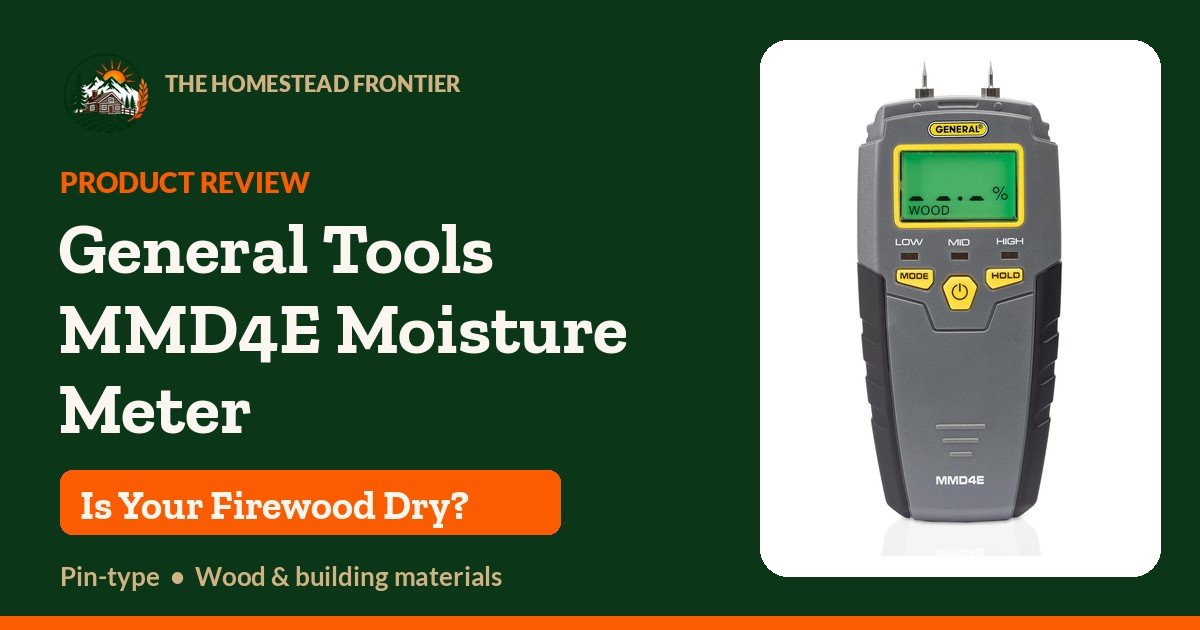
This page reviews the General Tools MMD4E Moisture Meter, which helps you check if wood is dry enough to burn. It explains how to use the meter, tips for testing firewood correctly, and other uses around the home.
As an Amazon Associate I earn from qualifying purchases.
If you heat with wood, you already know what wet firewood does: it hisses, smokes, gives you less heat, and leaves more creosote in the chimney. The trouble is that “seasoned” is hard to judge by eye. A split can look gray and checked on the ends and still be wet inside. The General Tools MMD4E Pin-Type LCD Moisture Meter is an affordable way to stop guessing. Push two pins into a split, and it shows a moisture percentage on a backlit screen.
What It Is
The MMD4E is a handheld, pin-type digital moisture meter from General Tools & Instruments. It has two modes: one for wood and one for building materials such as drywall. It reads the moisture in the material itself through its two stainless steel test pins, so you push the pins into the wood. (The Amazon listing calls it “pinless” in one spot. It isn’t. This is a pin meter.)
General Tools says it’s designed for woodworking, water damage restoration, building construction and home renovation. On a homestead, that means checking firewood, picking dry lumber and slabs for projects, and tracking down damp spots and leaks in the house, barn or shed.
Key Features and Specs
- Two modes: wood and building materials
- Measurement range: 5 to 50% (wood moisture equivalent) in wood; 1.5 to 33% in building materials
- Accuracy and resolution: ±2%, reading to 0.1%
- Backlit LCD with 0.3 in. (8 mm) high digits
- Low, mid and high moisture lights, plus an audible high-moisture alert
- HOLD button that freezes the reading on screen
- Replaceable stainless steel pins, 0.3 in. (8 mm) long; spare pins included, and replacements (#PIN3) are sold
- Pin cap doubles as a calibration checker
- “9V” battery included; auto power-off after 3 minutes of inactivity and a low-battery indicator
- Operating temperature: 32 to 122°F (0 to 50°C)
- Size and weight: 6.0 x 2.6 x 0.8 in., about 3 oz.; 1-year limited warranty
How to Test Firewood the Right Way
The EPA’s Burn Wise program says wood burns best at a moisture content of less than 20 percent, and it recommends testing wood with a moisture meter before you burn it. How you take the reading matters as much as the meter. The pins are only 8 mm long, so they read near the surface, and the outside of a log dries long before the core. If you test the bark or the end grain of an old split, you’ll usually get a reading that’s drier than the wood really is. Firewood folks commonly handle this by splitting first:
- Split a piece right before you test it. Pick a typical piece from the stack, not the driest-looking one on top.
- Turn the meter on in wood mode. Pull off the pin cap and the rubber pin sleeves, then power it on. It starts in wood mode; the MODE button switches to building materials.
- Push both pins into the fresh inside face. Don’t use the bark or the end grain. Press firmly, but don’t force the pins into wood that won’t take them.
- Read the number. Use HOLD if you want to freeze the reading. Checking a few pieces tells you more about the whole stack than one reading.
Don’t Let the 16% “HIGH” Light Fool You
This is the one quirk you need to know. The MMD4E’s color scale doesn’t line up with the firewood target. In wood mode it lights up like this:
- 5 to 11.9%: LOW (blue light)
- 12 to 15.9%: MID (green light)
- 16 to 50%: HIGH (red light and a beep)
So a split that reads 18% will flash red and beep at you, even though it’s under the EPA’s 20% guideline. For firewood, ignore the colored light and go by the number on the screen. Under 20% is your target.
Testing Firewood in Winter
According to the manual, the MMD4E is rated to operate from 32 to 122°F. That’s a problem if your woodpile is outside in January. Don’t take readings on frozen logs out in the yard. Instead, bring a piece inside and let it warm up to room temperature. Then split it and test the fresh face. It’s an extra step, but it’s the only way to get a reading you can trust when it’s below freezing outside.
Checking the Calibration
The pin cap has a small circuit board with a fixed resistor inside it. To check the meter, take off the cap, power the meter on in wood mode, and push the pins into the two small holes in the cap. The manual says a properly calibrated meter will read 18.3% ±1%. It’s a quick check if you ever start doubting your readings.
Beyond Firewood: Building Materials Mode
Press MODE and the meter switches to its building-materials scale (1.5 to 33%). That makes it handy around the rest of the place:
- Selecting dry lumber and slabs before a building or woodworking project
- Checking drywall, subfloors, walls and ceilings for damp spots after a spill or a leak
- Hunting down leaks. The manual’s tip is to take readings in several spots. The leak is where the meter reads highest.
Things to Know
- Treat the number as a guide. General Tools says wood readings are affected by ambient humidity and the density of the wood species. It’s plenty good for “is this ready to burn?”, but it isn’t a lab test.
- It reads near the surface. With 8 mm pins, always split and test the inside face. A reading from the outside of a round tells you very little.
- Don’t force the pins. The manual warns against driving the pins into hard surfaces. Dense, dry hardwood can be tough to get into. The pins wear over time, so it’s good that replacements are available.
- The pins are very sharp. Put the cap back on when you’re done, and keep it away from kids.
- It measures material moisture, not air humidity or mold. Some listings lean on “humidity” and “mold tester” wording. What it actually does is tell you how wet the wood or drywall is.
- Don’t use it around flammable or explosive gases, per the manual.
Who It’s For
This meter is for anyone who burns wood for heat and wants to know, not guess, whether their wood is ready. It’s useful if you’re buying cord wood and want to check it before you pay, cutting your own and deciding what to burn this year and what to leave for next, or deciding which stack to bring in first. It also earns its keep for small building projects and leak hunting. If you need deep readings in thick timbers or a meter with species correction, look at a more advanced model. For firewood, this one covers the basics well.
The Bottom Line
The General Tools MMD4E is a simple, affordable pin meter that gives you a real number for your firewood. Split a piece, test the fresh inside face, and aim for under 20%. Ignore the red HIGH light between 16 and 20%, and bring your wood indoors to warm up before testing in winter. Do that, and you’ll burn drier wood, get more heat, and send less creosote up the chimney.
Prefer to watch or listen? More practical homestead tips are on our YouTube channel — short, useful, no fluff.
Get Weekly Homestead Know-How That Actually Works
Practical tips on gardening, food preservation, DIY repairs and self-reliance, straight to your inbox. Free, no fluff.
Free. Unsubscribe anytime. We never share your email.